

THE MARK OF GOD: A DIVINE SEPARATION BETWEEN RIGHTEOUSNESS AND JUDGMENT By: Major Frank Materu
Key Scripture:
“And the Lord said to him, ‘Go through the midst of the city, through the midst of Jerusalem, and put a mark on the foreheads of the men who sigh and cry over all the abominations that are done within it.’”
— Ezekiel 9:4 (NKJV)
________________________________________
Introduction
The ninth chapter of the Book of Ezekiel stands as one of the most solemn and spiritually intense passages in the Old Testament. It paints a vivid picture of divine judgment and the distinguishing mercy of God. This chapter unveils the reality that while God is merciful and long-suffering, His holiness demands justice, and His righteousness requires separation between those who honor Him and those who rebel against Him.
Ezekiel, the prophet and priest, received a series of visions from God concerning the spiritual corruption of Jerusalem. In chapter 8, he was shown the great abominations committed within the temple—idolatry, corruption among priests, and the defilement of God’s sanctuary. In chapter 9, judgment follows immediately after exposure. The Lord calls for heavenly executioners to pass through the city, to destroy without mercy all who persist in rebellion. Yet before destruction begins, a man clothed in linen—symbolizing purity and divine authority—is sent ahead to mark those who mourn and grieve over sin.
This divine “mark” represents God’s seal of protection upon the righteous. It is not merely a physical symbol but a spiritual sign of ownership and covenant—a token that separates the repentant from the rebellious. In this lesson, we will explore the profound spiritual truths contained in Ezekiel chapter 9, understanding how it reveals the character of God, the seriousness of sin, the value of intercession, and the power of divine separation. The message is not only for ancient Jerusalem but also for today’s Church and believers around the world who live in times of moral decay.

________________________________________
THE CALL TO JUDGMENT
“Then He called out in my hearing with a loud voice, saying, ‘Let those who have charge over the city draw near, each with a deadly weapon in his hand.’”
— Ezekiel 9:1
The vision begins with a commanding voice from God, calling forth six men—angelic executors of divine justice—each carrying a weapon of destruction. Alongside them stands a seventh figure, clothed in linen, holding a writer’s inkhorn. These heavenly beings represent the sovereignty of God over all creation. Nothing happens in the spiritual or physical realm without His command.
This scene mirrors the reality that God governs judgment with precision and righteousness. The weapons signify the seriousness of divine wrath; the inkhorn represents the mercy of God, always preceding destruction. Before punishment comes, God ensures that those who belong to Him are identified and protected.
In this moment, we see that divine judgment is not chaotic but ordered. It begins with a command from heaven. The same principle is found throughout Scripture. In Amos 3:7, it is written: “Surely the Lord God does nothing unless He reveals His secret to His servants the prophets.” God never acts in darkness. He always announces His intentions and provides a way of escape for the faithful before executing justice.
This call to judgment reveals two aspects of God’s nature: His justice and His mercy. The same God who commands destruction also appoints protection. It teaches us that divine holiness cannot coexist with persistent wickedness, and yet divine love never abandons the righteous amidst corruption.
________________________________________
THE MARK OF MERCY AND DIVINE DISTINCTION
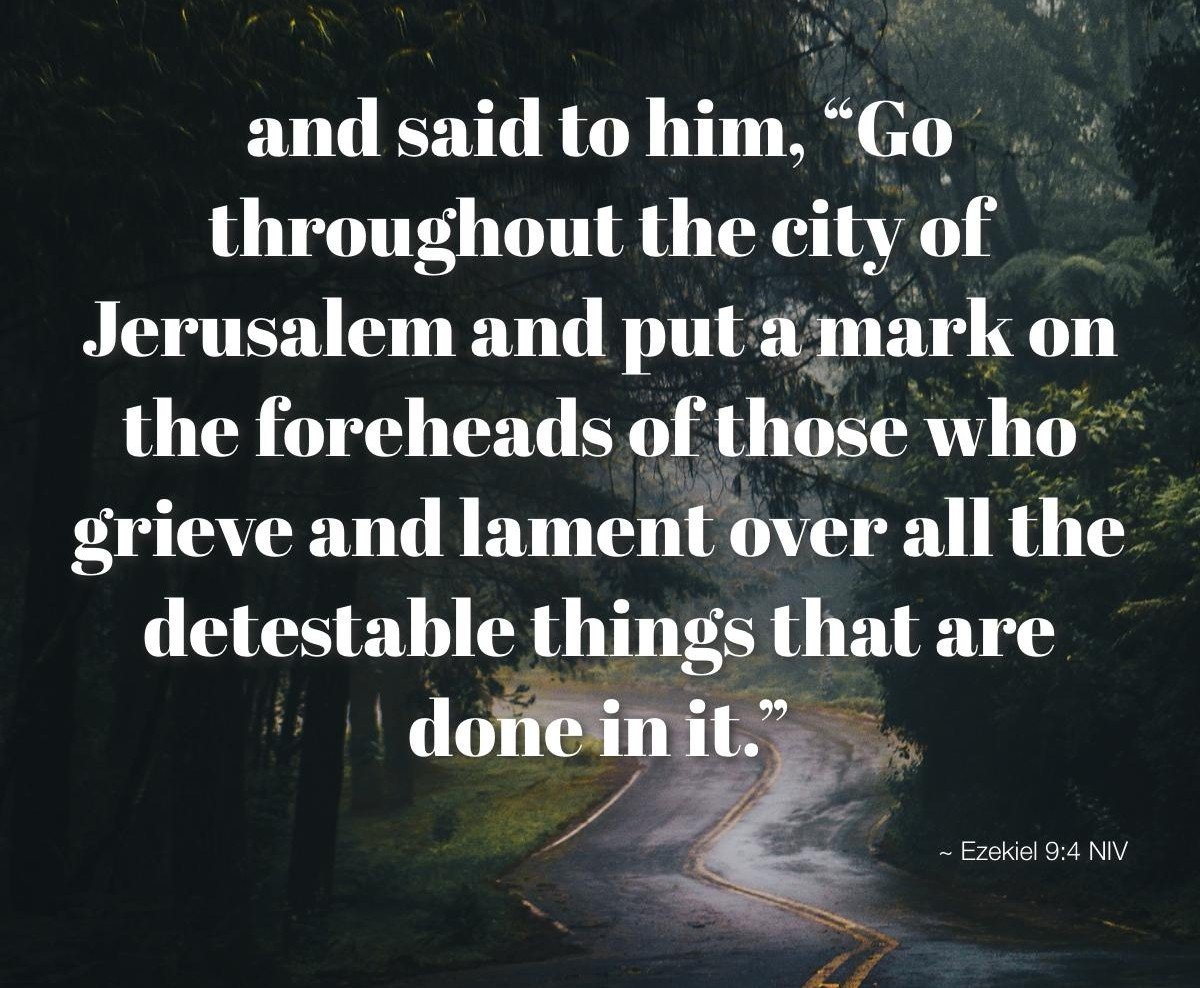
“Go through the midst of the city, through the midst of Jerusalem, and put a mark on the foreheads of the men who sigh and cry over all the abominations that are done within it.”
— Ezekiel 9:4
Before judgment is released, God instructs the man clothed in linen to go through the city and place a mark on the foreheads of all who mourn over sin. This mark is a divine sign of ownership—a spiritual seal distinguishing the faithful from the unfaithful.
This concept of divine marking appears throughout Scripture. In Exodus 12:7, the blood of the Passover lamb was placed on the doorposts to spare Israel from the destroyer. In Revelation 7:3, angels were commanded, “Do not harm the earth or the sea or the trees till we have sealed the servants of our God on their foreheads.”
The mark represents those who have separated themselves from sin through repentance and godly sorrow. It is not given based on religion, status, or outward appearance but on the inward posture of the heart. Those who “sigh and cry” for the sins of their nation reflect the heart of God—they are intercessors, standing in the gap, grieving for what grieves Him.
This moment reveals that even when a society is filled with wickedness, God knows His own. 2 Timothy 2:19 declares, “Nevertheless the solid foundation of God stands, having this seal: ‘The Lord knows those who are His.’” The mark symbolizes divine recognition and covenantal protection.
It is a timeless truth that in seasons of judgment, those who live in repentance and reverence remain under divine covering. The same principle applies to the Church today: God marks those who walk in holiness and intercede for their generation.
________________________________________
THE EXECUTION OF DIVINE JUDGMENT
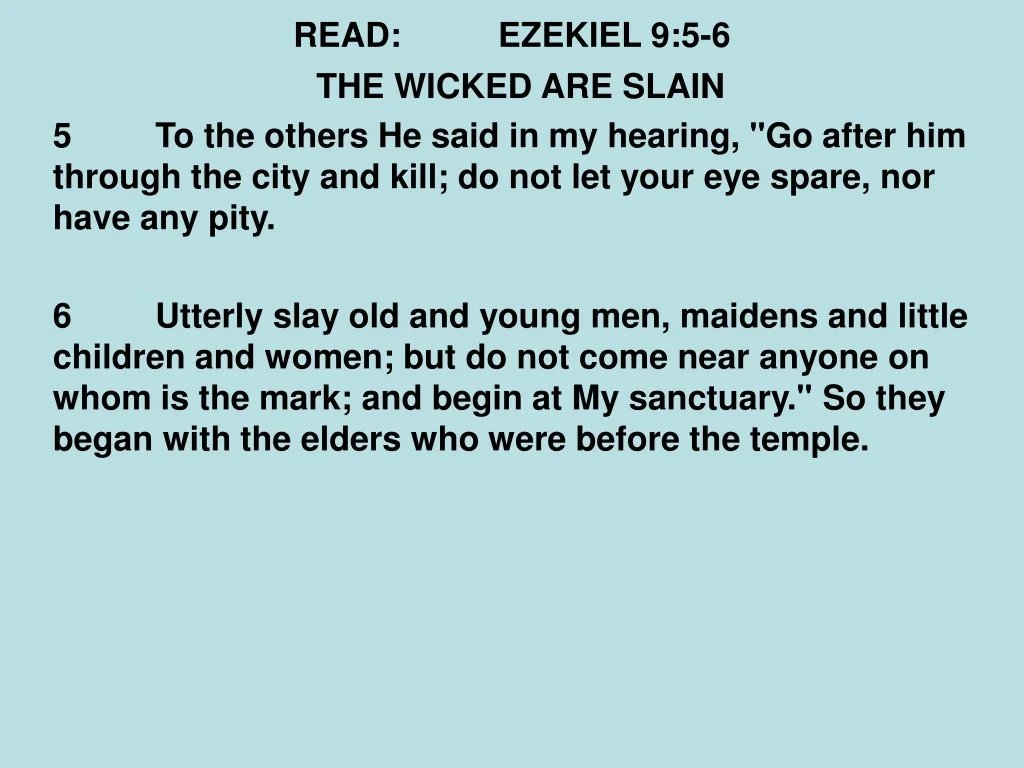
“To the others He said in my hearing, ‘Go after him through the city and kill; do not let your eye spare, nor have any pity. Utterly slay old and young, maidens and little children and women; but do not come near anyone on whom is the mark; and begin at My sanctuary.’”
— Ezekiel 9:5–6
After the righteous are marked, judgment begins. The command is clear—destroy without mercy those who persist in rebellion. Yet the instruction to begin at the sanctuary carries profound significance. It emphasizes that God’s judgment begins not with the unbelieving world, but with His own people. 1 Peter 4:17 echoes this truth: “For the time has come for judgment to begin at the house of God.”
The sanctuary, which was meant to be a place of holiness, had become defiled by hypocrisy and idolatry. The priests, instead of leading in righteousness, were participating in corruption. Therefore, God’s judgment starts within His house, purifying it before addressing the world outside.
This principle remains unchanged. The Church today is called to holiness. When it tolerates sin, compromise, and idolatry—placing worldly desires above devotion to Christ—God’s discipline comes to cleanse it. He disciplines those He loves, as written in Hebrews 12:6: “For whom the Lord loves He chastens, and scourges every son whom He receives.”
The executioners symbolize divine justice in motion. It is not cruelty but the necessary fulfillment of holiness. God’s holiness demands that sin be confronted, not ignored. Yet His mercy ensures that none of the marked—the faithful—are harmed. This shows us that even in the midst of wrath, God’s mercy remains active and protective.
________________________________________
THE DEPARTURE OF GOD’S GLORY
“Then the glory of the God of Israel went up from the cherub, where it had been, to the threshold of the temple.”
— Ezekiel 9:3
As the events unfold, the prophet witnesses something deeply tragic—the departure of God’s glory from the temple. The presence that once dwelt between the cherubim now moves toward the door, symbolizing withdrawal. This act reveals a profound truth: God’s glory cannot remain where sin is honored and holiness is despised.
Throughout Scripture, the glory of God represents His manifest presence, favor, and fellowship with His people. When sin dominates, His presence retreats. The same pattern is seen in 1 Samuel 4:21, when the ark of the covenant was captured and a child was named Ichabod, meaning “The glory has departed.”
Ezekiel’s vision shows us that the removal of God’s glory is not sudden but progressive. God does not abandon His people immediately; He gives warnings, sends prophets, and calls for repentance. But when there is continual rebellion, His presence lifts.
In personal terms, this teaches that unrepented sin causes spiritual distance from God. A heart that cherishes sin cannot host His glory. Yet when repentance and cleansing occur, His presence returns in fullness. The Church must continually guard the presence of God by walking in purity and obedience.
________________________________________
THE PROPHET’S INTERCESSION AND GOD’S RESPONSE
“So it was, while they were killing them, I was left alone; and I fell on my face and cried out and said, ‘Ah, Lord God! Will You destroy all the remnant of Israel in pouring out Your fury on Jerusalem?’”
— Ezekiel 9:8
Ezekiel’s reaction to the vision is that of a true intercessor. He falls facedown, crying out in anguish for the people. Despite witnessing their sins and rebellion, his heart is moved with compassion. This is the heart of a shepherd and a servant of God—grieving not only for the judgment but for the lost souls facing destruction.
Intercession is a divine response to revelation. When God reveals His impending judgment, He seeks those who will stand in the gap. Ezekiel 22:30 says, “So I sought for a man among them who would make a wall, and stand in the gap before Me on behalf of the land, that I should not destroy it; but I found no one.”
Ezekiel represents that kind of intercessor. His plea, though it does not stop the judgment, demonstrates that God’s heart is moved by compassion. He listens to the cries of those who intercede. It reminds us that prayer is not wasted even when the outcome seems fixed—because through intercession, God’s mercy is revealed, and a remnant is preserved.
In every generation, God seeks intercessors who will mourn over sin, pray for revival, and stand in defense of righteousness. These are the marked ones, whose hearts beat in alignment with God’s.
________________________________________
THE COMPLETION OF THE DIVINE MISSION
“Just then the man clothed with linen, who had the inkhorn at his side, reported back and said, ‘I have done as You commanded me.’”
— Ezekiel 9:11
The chapter closes with this solemn statement. The man clothed in linen returns to report that he has completed his task. The divine command has been fulfilled. This signifies that God’s decrees are always executed perfectly and completely.
There is a finality to divine justice. Once mercy has been offered and rejected, judgment follows with precision. Yet the return of the man in linen assures us that God’s system of justice and mercy is never arbitrary—it is orderly, fair, and complete.
The presence of this man, who symbolizes both intercession and record-keeping, parallels the role of Christ in the New Testament. Jesus, our High Priest, intercedes for us before the Father, marking us not with ink but with His own blood. His sacrifice ensures that believers are sealed with the Holy Spirit, as written in Ephesians 1:13: “Having believed, you were sealed with the Holy Spirit of promise.”
________________________________________
SUMMARY
Ezekiel 9 unveils the holy tension between divine mercy and divine justice. It shows that while God is patient and loving, He is also just and cannot overlook sin forever. The man clothed in linen symbolizes Christ’s ministry of intercession and redemption. The mark on the foreheads of the righteous represents the spiritual sealing of those who belong to God—those who mourn over sin and live in reverence.
Judgment begins at the house of God, reminding the Church of its sacred responsibility to remain pure and holy. The departure of God’s glory from the temple warns that sin drives away His presence, but repentance restores it. Through Ezekiel’s intercession, we learn that even in times of wrath, God listens to the cries of the righteous.
________________________________________
CONCLUSION
The message of Ezekiel 9 remains as relevant today as it was in the prophet’s time. God is still distinguishing between those who are His and those who persist in rebellion. The “mark” of God today is not physical but spiritual—it is the seal of the Holy Spirit upon those who have surrendered their hearts to Christ.
In an age filled with corruption, violence, and moral compromise, God still seeks men and women who will weep over sin and stand in the gap through prayer and holiness. The Church must not be silent while the world drifts into darkness. We must carry the heart of intercession, the burden of holiness, and the seal of divine ownership.
Those who walk faithfully before God will always be protected in times of judgment. The same Lord who marked the faithful in Jerusalem marks His own today. As Psalm 91:1 declares: “He who dwells in the secret place of the Most High shall abide under the shadow of the Almighty.”
________________________________________
THE CALL TO ACTION
Examine your heart before God. Are you marked by His Spirit? Are you among those who mourn for the sins of this generation, or have you become numb to the corruption around you? Today, God is calling His people to repentance, consecration, and renewed intimacy with Him.
Let your life be a temple filled with His presence, not a place of compromise. Stand in the gap for your family, your church, and your nation. Let your tears of intercession become the ink of divine mercy. The mark of God is not for those who are perfect, but for those who are humble, repentant, and faithful.
________________________________________
FINAL WORD OF ENCOURAGEMENT
Though judgment comes, mercy always precedes it. The mark of God remains a promise of divine protection and identity. In Christ, you are sealed, covered, and known by name. No evil can touch those who are marked by the blood of the Lamb.
Let this truth strengthen your faith: God knows you, loves you, and has marked you as His own. Walk in holiness, persevere in prayer, and never lose your compassion for the lost. In the midst of chaos, those who are marked by God will shine as lights of hope and righteousness.
________________________________________
SALVATION PRAYER
If you have not yet received the mark of God through salvation in Christ Jesus, you can do so now. Pray this prayer from your heart:
Heavenly Father, I come before You today, acknowledging that I am a sinner in need of Your mercy. I believe that Jesus Christ is the Son of God, who died for my sins and rose again for my justification. Lord Jesus, come into my heart, cleanse me, and mark me with Your Holy Spirit. I surrender my life to You from this day forward. Write my name in the Book of Life, and let Your presence dwell within me forever. In Jesus’ name, I pray. Amen.










Leave a Comment